 |
| Winter Luxury Pumpkin |
Tuesday, June 4, 2013
Pumpkin Planting, Take II
It has been a beautiful, sunny, breezy day. I started to tackle weeding the raspberry patch and discovered a new cucumber sprouted, as well another sunflower and several nasturtiums. The Sugar Pie pumpkin seeds I planted in May haven't shown any signs of germinating, so I planted Winter Luxury pumpkin seeds today in their place.

Sunday, June 2, 2013
After The Rain
I have typed the title of this post hesitantly. After a clear day yesterday and a sunny, warm morning today, thick, grey clouds are rolling in and I just spotted lightning over the downtown area. More rain? I hope not!
A few pictures of the garden, taken this afternoon...

Beans! My beans have sprouted! I have no idea why this fills me with such glee, but it does. These are "Tene's Beans", a dry bush bean. My Speckled Algonquin, Anasazi, and Beurre de Rocquencourt beans have all started to sprout as well. Oh, happy day!
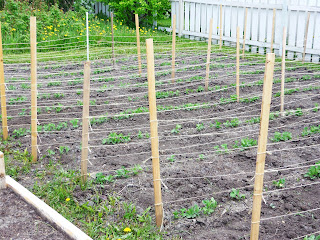
Green Arrow peas are coming along nicely.

Determinate tomatoes (Yellow Cherry and Cole) in one of the raised beds.

This is Butters, another neighbour's cat. She loves head-pettings and being talked to, but loathes being picked up and won't be held. Super affectionate and likes people...but not other cats. This proves to be a problem when she wanders into our house for a visit. Visits outside work out much better for everyone.

Chocolate mint in the foreground, a flower bed in the making (stone bed), buckets of tomatoes lining the fence, a bed of kohlrabi (wood), and the potato patch ("North" garden) right in front of the house. Swiss Giant Pansies and dahlias in containers on the step. Dandelions everywhere.

A Russet potato plant in the freshly-hoed patch!
 The "South" garden, also right in front of the house, with Anasazi & Beurre de Rocquencourt beans, sage, nasturtiums, cucumbers, green onions, red cabbage (transplants), broccoli (transplants), and cauliflower (transplant) planted. The tree furthest to the right is a crab apple in bloom. In the foreground, containers of Sunspot sunflowers. Wooden containers to the right have Watermelon radish and various greens planted in them.

Indeterminate tomatoes, peppers, and rain barrels along the side of the house. (Better Homes & Gardens material, this is not...)

At the back of the house: tomatoes, corn, a young apple tree, Sweet Siberian melons (maybe...I have lost track of what kind of melons I've grown...could be Cream of Saskatchewan instad!), and Sugar Pie pumpkin planted. The flowering tree in the back alley is a crab apple, a different kind than the one on our front lawn.

Assorted greens: Pac Choi, Red Oak Leaf lettuce, Perpetual Spinach, Black Seeded Simpson lettuce, Mesclun mix, etc. Also weeds in there, but I'll have to let things grow a bit more before pulling anything out. I don't want to yank out lettuce and leave the dreaded pigweed.

A few pictures of the garden, taken this afternoon...

Beans! My beans have sprouted! I have no idea why this fills me with such glee, but it does. These are "Tene's Beans", a dry bush bean. My Speckled Algonquin, Anasazi, and Beurre de Rocquencourt beans have all started to sprout as well. Oh, happy day!

Green Arrow peas are coming along nicely.

Determinate tomatoes (Yellow Cherry and Cole) in one of the raised beds.

This is Butters, another neighbour's cat. She loves head-pettings and being talked to, but loathes being picked up and won't be held. Super affectionate and likes people...but not other cats. This proves to be a problem when she wanders into our house for a visit. Visits outside work out much better for everyone.

Chocolate mint in the foreground, a flower bed in the making (stone bed), buckets of tomatoes lining the fence, a bed of kohlrabi (wood), and the potato patch ("North" garden) right in front of the house. Swiss Giant Pansies and dahlias in containers on the step. Dandelions everywhere.

A Russet potato plant in the freshly-hoed patch!


Indeterminate tomatoes, peppers, and rain barrels along the side of the house. (Better Homes & Gardens material, this is not...)

At the back of the house: tomatoes, corn, a young apple tree, Sweet Siberian melons (maybe...I have lost track of what kind of melons I've grown...could be Cream of Saskatchewan instad!), and Sugar Pie pumpkin planted. The flowering tree in the back alley is a crab apple, a different kind than the one on our front lawn.

Assorted greens: Pac Choi, Red Oak Leaf lettuce, Perpetual Spinach, Black Seeded Simpson lettuce, Mesclun mix, etc. Also weeds in there, but I'll have to let things grow a bit more before pulling anything out. I don't want to yank out lettuce and leave the dreaded pigweed.

Oh, my.....it just started to POUR. :/ We already have 23 garbage cans of varying sizes that we use as rain
barrels, one actual rain barrel, and a number of buckets - all are full
of water and could have been filled once over again. And now more rain??
At least I won't
have to water anything for a while.
Thursday, May 30, 2013
When It Rains...
For the record, I was running around the house last night in a floor-length flannel nightie with the thermostat turned up. At the end of May. BRRR!
It started sprinkling the afternoon of the Great Tomato Transplant, and has been raining - often times, pouring - since. Every available rain barrel, bucket, and large container we have is filled at this point, and it's still raining. My bucket-tomatoes are drenched, but still alive. Now we need some sunshine, heat, and a light breeze so things can start growing in earnest.
When it does dry out, I have hours of weeding ahead of me...
Monday, May 27, 2013
The Great Tomato Transplant
Yesterday, I planted my tomatoes, peppers, eggplants, and tomatoes in pots and raised beds outdoors. As carefully as one tries to plan, unexpected things happen and when it comes to what actually gets put in the garden, there are always a few surprises at the last minute. I planted...
- Doe Hill peppers (2 or 3) and jalapeno peppers (2 or 3). Possibly 1 King of the North Pepper. Time will tell.
- Casper, Ping Tung, and Vittoria Eggplants (4 total). This blog might be called, I Will Grow Eggplants but judging by the looks of the poor little ones I have, maybe I should change the title to the less-ambitious-yet-still-optimistic, I Will Plant Eggplants.
- Marigolds
- Tomatoes. LOTS of tomatoes.
The King of the North pepper seeds I received in a trade earlier this year and started in April turned out to be tomatoes instead. I was extremely careful about labeling my seedlings, so whoever I did the trade with either got things mixed up, or has a sick sense of humor. *L* As a result, I have far fewer peppers than I wanted, and ended up with 33 tomato plants!
Realizing we didn't have enough space for all of them, I prioritized by the varieties I most wanted to grow and the health of the plants, and went to work planting those. I was left with 13 plants, which I decided I'd try to give away. Instead, R pulled out a bunch of the buckets we use for rainwater, placed them along the fence by the potato patch, bought several large bags of soil, and I planted the extras in those yesterday afternoon.
If they all do well, we are going to have plenty to eat fresh, dice and freeze, and share with friends and family.
The timing was good, as it started to sprinkle late yesterday afternoon. Today, we have had heavy showers with hail, thunder, and lightning. The rain barrels are almost full now, and there are puddles in the driveway and south garden. The bucket-tomatoes, which have no drainage, are soaked but don't appear to be waterlogged. I'd be mighty ticked if they croaked within 24 hours of my backbreaking (not sure I mean that figuritively...) work planting them yesterday!
Saturday, May 25, 2013
You Can't Hide the 'Nip
 After several days of clouds, drizzle (no real rainfall, darn it), and very cool temps, I awoke this morning to bright sunshine and warm weather. Last night was the first all-night sleepover on the front step for my plants. The tomatoes seemed to fare well, as did the peppers. R. made a shade tent for them this morning, as it is shaping up to be a hot day.
I think my melon plants got zapped. :(
To replace them, this morning I planted Cream of Saskatchewan melon seeds and Sugar Pie Pumpkin seeds in the containers where the Sweet Siberian melons were intended to grow. Fingers crossed they do well. If the Sweet Siberians snap back to life, I will do my best to find a place for them in the South garden.
 After planting the melon and pumpkin seeds, I rounded the corner of the house to find Karl indulging in the catnip. The catnip we had deliberately placed off the round, on a plank of wood across layed the top of a rain barrel so the poor thing's roots would have a chance to establish themselves. Karl has the transplant gnawed pretty much down to the soil. I think we're going to have to buy another transplant.
 R's brother just dropped by for a quick visit and gave us two Butternut squash plants! Love Butternut squash. Have no idea where we are going to put them, but I will find a place!
Update - We took a trip to the nursery late this morning to get some transplants (including catnip!). I prefer being able to grow and then harvest my vegetables from seeds. Strangely, I don't feel like I've grown them/that they're really mine if I use transplants. I also am not thrilled about growing hybrids. Sometimes things don't go according to plan and my seedlings croak, so Plan B is the nursery!
We bought broccoli, cauliflower, red cabbage, green cabbage, and more corn and strawberries (half of the last batches of corn and strawberries we recently bought and planted got wiped out by a wind storm). We planted those this afternoon, mostly in the South garden, and I filled in any extra space with green onion seeds and nasturtiums.
.
Saturday, May 18, 2013
The Ancient Ones
More planting this morning. This is the first May holiday weekend in years that we haven't seen rain, cool weather, and/or snow. On the contrary, it has been a sunny, warm day thus far. It's 12:35pm and counting, so the day is young. A little rain, I would welcome. But please, Lord, no snow!
In the raised beds along the driveway, I planted carrots ("Nantes" and "Jaune du Doubs") and Purple Vienna Kohlrabi (something new to try this year). Along the edge of the potato patch (North garden), I planted Algonquin Speckled beans, which are a rare heirloom dry bush bean.
In the South garden, I planted yellow wax beans ("Beurre de Rocquencourt"). I only planted a few of these last year, and they were so sweet and delicious when cooked that I promised myself I would plant more this year and freeze a bunch for the winter. I also planted a few cucumber seeds ("Beit Alpha"), and three rows of Anasazi beans (another new one for me this year).
The Anasazi beans are an heirloom variety sent to me by an online friend, Mike, who is from Arkansas. Mike has been kind enough to send me all sorts of heirloom vegetables to try, some obtained from his friends in the Mennonite community there, some from American heirloom seed companies, and others that he has saved from his own crops. He is fortunate enough to be able to garden much of the year (9 months!) and last year started a large community garden for his church. It was very successful, providing food for many families. He enjoys what he does, and is hoping to have more people participate in the upkeep of the garden this year.
 Anasazi beans are supposed to have a smooth texture and meaty, sweet taste. They are an old variety and were first planted by the native people of the Four Corners region of the United States. I am told that "Anasazi" is a Navajo word best translated as,
"the ancient ones".
More history from eHow.com:
"Native to the North American Southwest region, the Anasazi bean was named after the cliff-dwelling Native American people that inhabited the area now known as the four corners of Arizona, New Mexico, Colorado and Utah. The Anasazi bean is thought to have been a staple in the diet of the native people who lived in this region. While not much is known about the specific origins of the bean, evidence suggests that native people have been cultivating and consuming them for more than 1,500 years."
Very cool, n'est-ce pas? I am looking forward to seeing how they grow. From what I understand, they are a "half runner" bean...not a vine, not a bush, but something in between. I haven't used supports or a trellis, as Mike said that the plants tend to support each other. Fingers crossed! *L*
Friday, May 17, 2013
Tomato Boot Camp
For the last week, I have been gradually hardening off our plants for the garden. The peppers and melons are adapting quickly, but the tomatoes seem more fragile. They go out for 2 hours/day. Hoping to increase that amount of time over the coming week.

The tomatoes, peppers, melons, and eggplants...

Pansies, marigolds, and herbs (thyme, Genovese basil, opal basil, and summer savory) getting some sun on the cat tree...
This evening, I planted parsnips ("Hollow Crown"), beets ("Detroit Dark Red"), and dry bush beans ("Tene's Beans") in one of the raised beds along the driveway. Tene's is a variety that is apparently similar to marrowfat beans, which are described as having a creamy, bacon-like flavour. (See the Ark of Taste )
I also planted a few nasturtium seeds ("Dwarf Cherry Rose") in the bed where I've already planted kale, chard, and endive. Nasturtiums are supposed to protect kale and cabbage (and lots of other vegetables!) from pesky insects. They are also supposed to thrive in awful soil. That is great news, as the soil in the kale bed contains a lot of clay. What a crispy, cracked surface. We'll see what grows!
Subscribe to:
Posts (Atom)